



MEMORIAL WAR
The Monumento ai Caduti (War Memorial) of Montecarotto is a monumental work created by combining two monuments built at different times but combined into a single architectural composition.
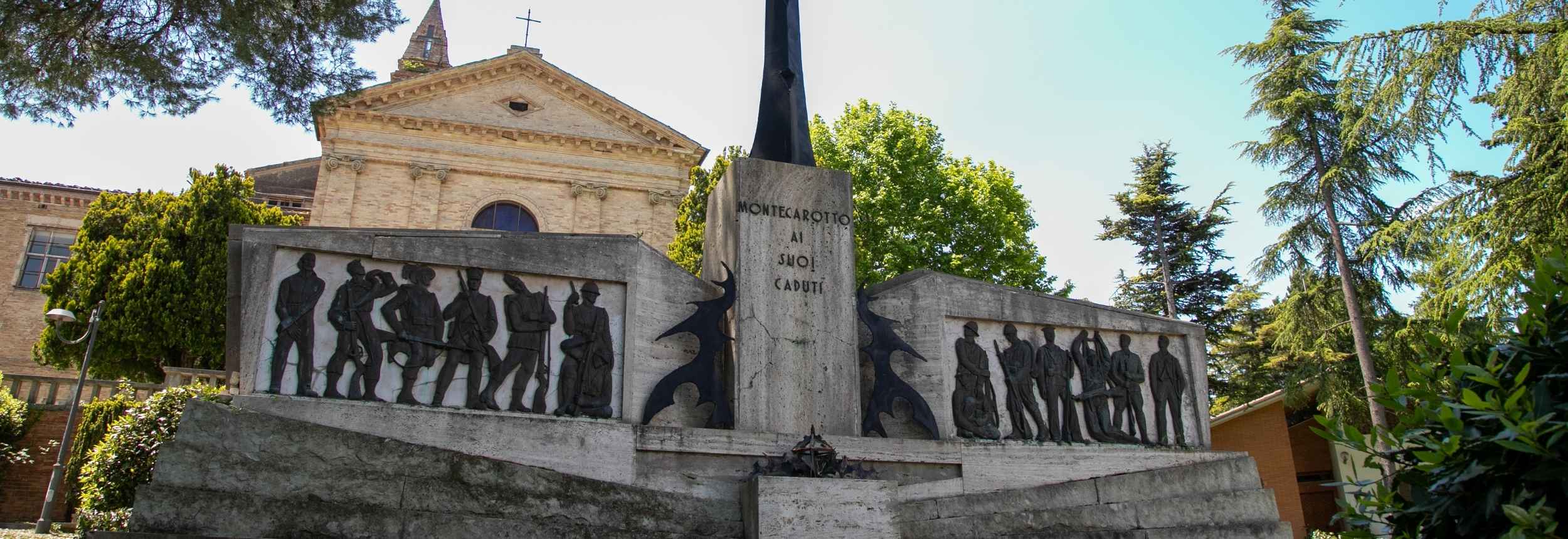
MONUMENT TO THE FALLEN OF THE FIRST WORLD WAR
The War Memorial of the First World War, created by the Venetian sculptor Vito Pardo in the early 1930s, has the particularity and originality of being made up of distinct elements and materials, perfectly integrated with the imposing facade of the church of San Francesco.
The marble part is made up of winged statues supported by shelves and tombstones, placed halfway up the façade: on the left an angel, representing the Winged Victory, holds a shield with the municipal coat of arms and is placed above the tombstone with the inscription “vivunt” (They live, in Latin), in reference to the memory of the fallen; on the right a woman, symbolizing turreted Italy, holds a cross above the tombstone with the words “monent” (Warned, in Latin), as a warning to the tragedy of war.
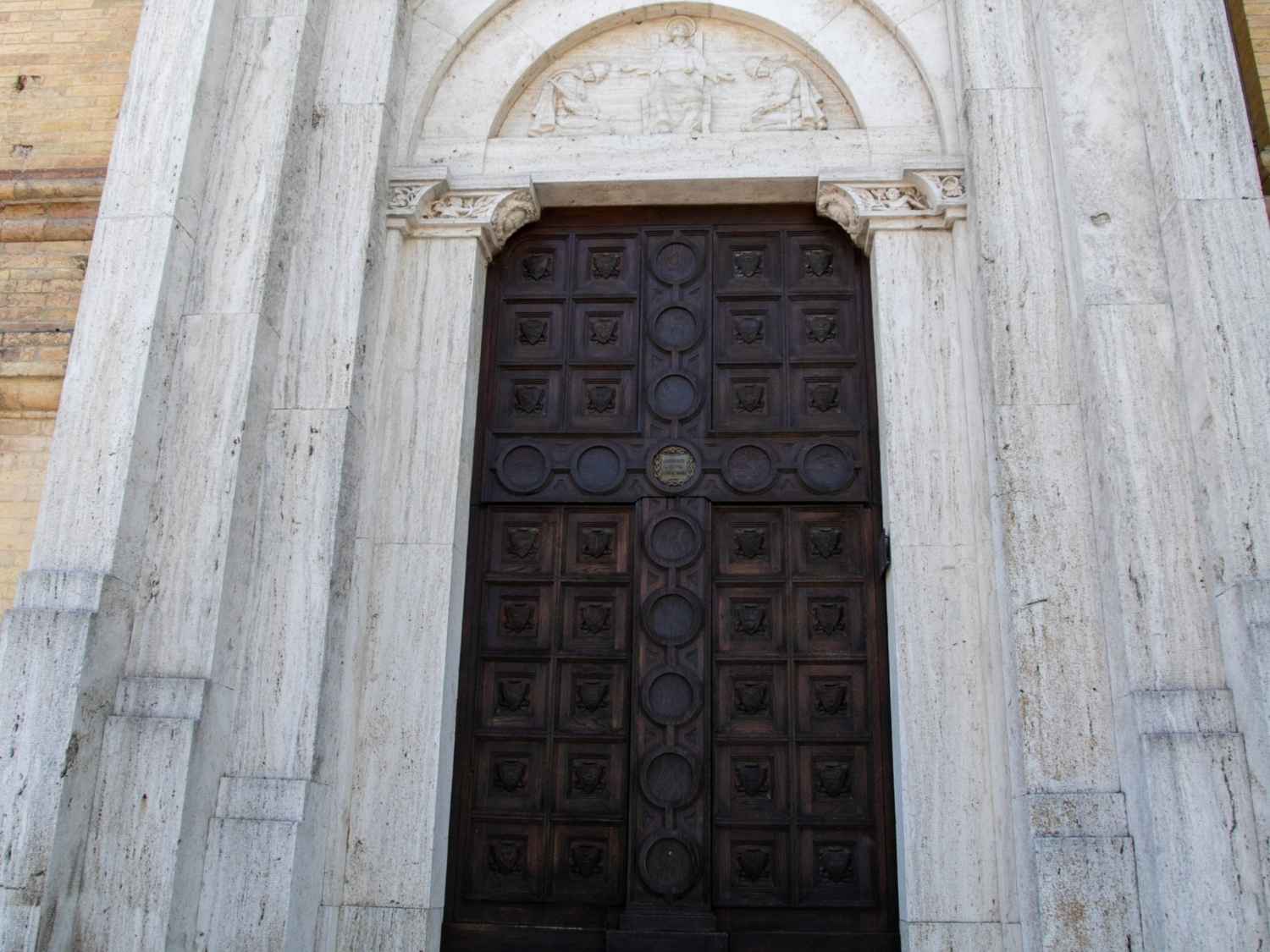
An integral part of the monument is the monumental door, of which the original design is preserved at the Museum of “Mail Art”: it consists of thirty-two panels representing the coats of arms of the Italian Royal Army, the Royal Navy and the Royal Air Force, carved in bas-relief on oak wood, divided into four parts by a Latin cross made up of fourteen roundels. The central panel of the cross is made up of a brass round, bearing the inscription “Montecarotto to his sons who fell in the war” surrounded by a crown of intertwined ribbons.
The lunette above the lintel of the portal depicts a saint in monastic habit, perhaps St. Francis, with his arms outstretched towards two soldiers kneeling on either side of him, the one on the left holds a flag, the one on the right a rifle.
The monument leads up to the bell tower, with a pyramidal spire showing four glass crosses, one for each cardinal point.
MONUMENT TO THE FALLEN OF ALL WARS
This monument was inaugurated in 1971. It was built along the slope that leads from Via XX Settembre to the top of the hill of the church of San Francesco. The bronze stele that stands out from the travertine complex, indicates the continuity with the facade of the Church, on which the MONUMENT TO THE FALLEN OF THE FIRST WORLD WAR is placed, designed by Vito Pardo and built in the early thirties (Monument to the fallen of the First World War).
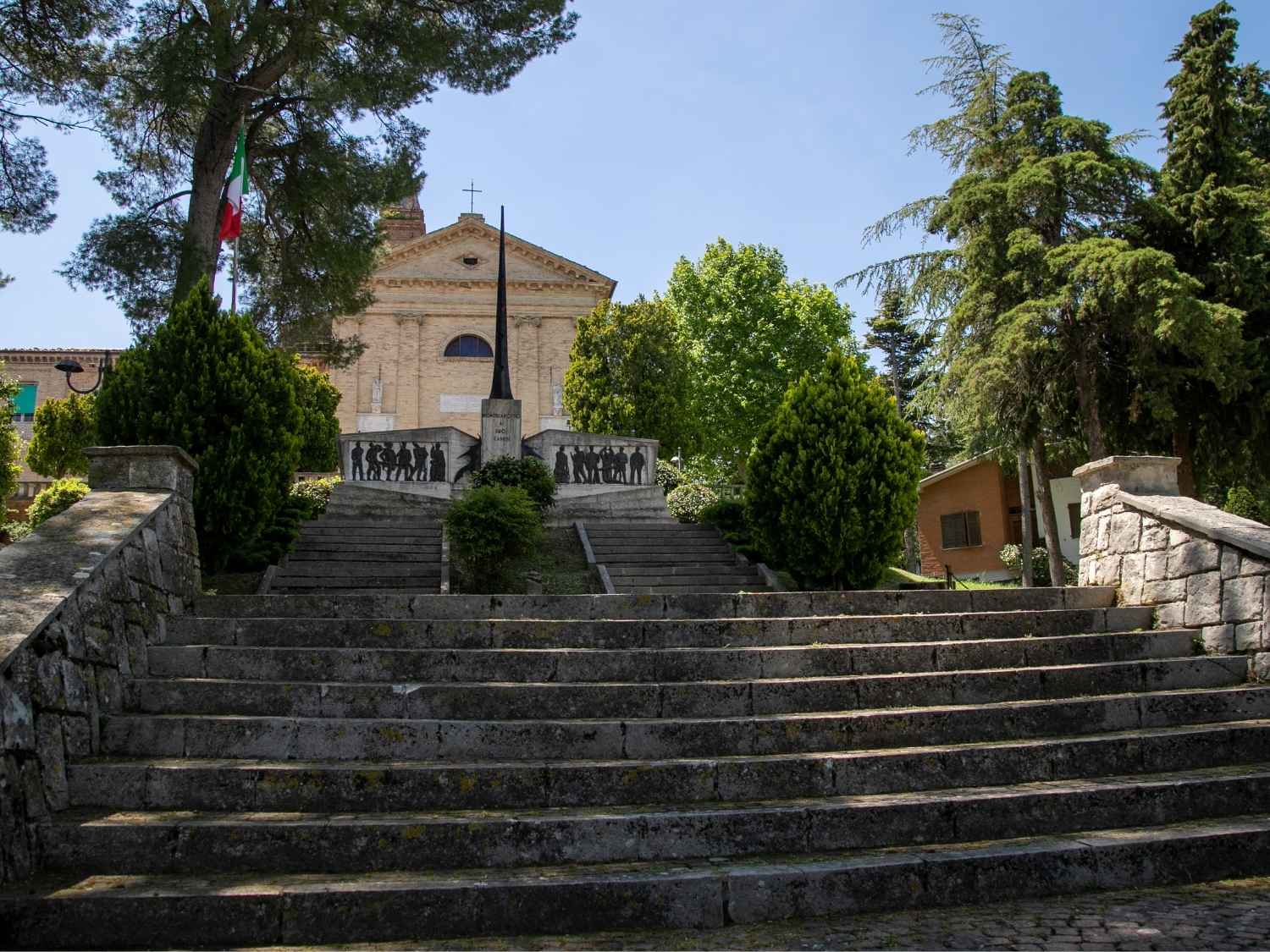
Access to the monument is by means of a staircase that physically and ideally connects the two monuments, located on different levels of the hill and united by a ascent that aims to evoke feelings of asceticism to the values of the homeland and the highest sacrifice of a soldier. The monument to the fallen of all wars covers the battles of the Risorgimento and both world wars, passing then to the colonial wars.
On the sides of the altar, there are two other volumes, on which bronze panels with stylized reliefs of fighters portray and homage the memory of the Italian soldiers who died in battle. The work was created based on a design by Professor Schiavoni of Arcevia, who took up the original idea of Vito Pardo, that is, of building a large staircase that embraced the hill of the church of San Francesco.
Along the staircase, a stone commemorates the place where the young Tarcisio Tassi, partisan soldier, died in 1944 during the clashes of the Battle of Montecarotto, one of the fundamental stages of the Liberation of the province of Ancona (25-30th July 1944), in which the local partisans fought, together with the patriots of the Maiella Brigade, and a detachment of the Polish Second Army Corps. The monument can be reached from Via XX Settembre via a wide paved staircase that leads to an altar, on the top of which stands a bronze stele, resting on a travertine parallelepiped.